
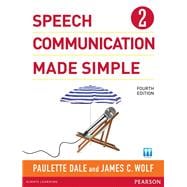
Speech Communication Made Simple 2 (with Audio CD)
by Dale, Paulette; Wolf, James C.Edition: 4th
Format: Paperback
Pub. Date: 2013-01-03
Publisher(s): Pearson Education ESL
 Other versions by this Author
List Price: $47.07
Buy New
Usually Ships in 2-3 Business Days
$44.83
Buy Used
Usually Ships in 24-48 Hours
$32.99
Rent Textbook
Select for Price
eTextbook
We're Sorry
Not Available
How Marketplace Works:
- This item is offered by an independent seller and not shipped from our warehouse
- Item details like edition and cover design may differ from our description; see seller's comments before ordering.
- Sellers much confirm and ship within two business days; otherwise, the order will be cancelled and refunded.
- Marketplace purchases cannot be returned to eCampus.com. Contact the seller directly for inquiries; if no response within two days, contact customer service.
- Additional shipping costs apply to Marketplace purchases. Review shipping costs at checkout.
Summary
The only two-level series that prepares students for success in both presentations and academic discussions, Speech Communication Made Simpletakes an interactive, accessible approach to building confidence as a speaker. Students learn how to present in a variety of genres, effectively use voice and props, and lead or participate in discussions. With its lighthearted and engaging approach, the text helps students acquire speech communication and listening skills that they can apply immediately and throughout their lives. Features: Varied speech genres that range from personal story to persuasive. Broad array of projects including interviews and group discussions. Scaffolded approach that includes directed discussion of a model presentation; skill-building exercises for selecting a topic, organizing information, and more; practicing aloud; and finally, delivering a speech. Pronunciation Practicethat focuses on American English pronunciation patterns that are difficult for most non-native speakers of English. Playing with Sayingssection that presents idiomatic sayings in popular use and related activities to help students understand and use them to enhance their spoken communication. Useful language boxes that illustrate effective ways to begin speeches or participate in discussion. CD-ROM with MP3audio that includes sample speeches and all pronunciation activities Teacher's manual (available separately athttp://pearsoneltusa.com/speechcom) with teaching suggestions, answer keys, and quizzes.
Table of Contents
Scope and Sequence
Preface: To the Teacher
About the Authors
Introduction: To the Student
CHAPTER 1: DEVELOPING SELF-CONFIDENCE
I. How to Control Presentation Anxiety
II. Presentation Preview
III. Pronunciation Practice: Final Consonants
IV. Playing with Sayings: Saying with Final Consonant
V. Presentation Project: A speech about yourself
Method A: Picture Story
Method B: The “Old Bag” speech
CHAPTER 2: DELIVERING YOUR MESSAGE
I. Using Body Language
II. Using Your Voice Effectively
III. Different Modes of Speech Delivery
IV. Effective Use of Notes
V. Presentation Preview
VI. Pronunciation Practice: —ed Endings
VII. Playing with Sayings: Sayings with —ed Endings
VIII. Presentation Project: An Exceptional Experience
CHAPTER 3: PUTTING YOUR SPEECH TOGETHER
I. Preparing the Speech
II. Purpose of Outlines
III. Outlining Supporting Points
IV. Presentation Preview
V. Pronunciation Practice: Contractions
VI. Playing with Sayings: Sayings with Contractions
VII. Presentation Project: A Point of View
CHAPTER 4: POWERFUL PRESENTATION AIDS
I. Guidelines for Using Presentation Aids
II. Types of Presentation Aids
III. Presentation Preview
IV. Pronunciation Practice: —s as [s], [z], and [əz]
V. Playing with Sayings: Sayings with —s Endings
VI. Presentation Project: A Speech with Presentation Aids
CHAPTER 5: SPEAKING TO INFORM
I. Preparing for the Informative Speech
Analyzing Your Audience
Choosing Your Topic
Narrowing Your Topic
Gathering Information
Preparing Presentation Aids
Organizing Your Speech
II. Presentation Preview
III. Pronunciation Practice: Phrasing and Pausing
IV. Playing with Sayings: Sayings with Pauses
V. Presentation Project: A speech to Inform
CHAPTER 6: UNDERSTANDING INTERPERSONAL COMMUNICATION
I. Perceptions and Interpersonal Communication
II. Avoiding Miscommunications
III. Interpersonal Communication Styles
IV. Interpersonal Communication during a Job Interview
V. Presentation Preview
VI. Pronunciation Practice: Intonation in Sentences with Two or More Word Clusters
VII. Playing with Sayings: Sayings with Two-Word Clusters
VIII. Presentation Project: Job-Interview Role Play
CHAPTER 7: LISTEN TO LEARN
I. Listening Self-Evaluation
II. Bad Listening Habits and Their Cures
III. Listening Skills
Listening for Main
Ideas and Details
Distinguishing between Facts, Opinions, and Inferences
Evaluating What You Hear
Following Oral Directions
IV. Presentation Preview
V. Pronunciation Practice: Linking
VI. Playing with Sayings: Sayings with Linking
VII. Presentation Project: Impromptu Speech
CHAPTER 8: PROBLEM-SOLVING GROUP DISCUSSIONS
I. Brainstorming
II. Identifying Topics for a Problem-Solving Discussion
III. Path to Successful Problem-Solving for Group Discussions
IV. Path to Being an Effective Group Leader
V. Path to Being a Responsible Group Member
VI. Presentation Preview
VII. Pronunciation Practice: Stress within Words
VIII. Playing with Sayings: Sayings with Multisyllabic Words
IX. Presentation Project: Problem-Solving Group Discussion
CHAPTER 9: SPEAKING TO PERSUADE
I. Preparing for the Persuasive Speech
Choosing Your Topic
Determining Your Specific Purpose
Analyzing Your Audience
Gathering Information
Preparing Presentation Aids
Organizing Your Speech
II. Presentation Preview
III. Pronunciation Practice: Stress within the Sentence
IV. Playing with Sayings: Sayings with Contrastive Stress
V. Presentation Project: A Speech to Persuade
CHAPTER 10: DARE TO DEBATE
I. Propositions
II. Organization of a Debate
III. Constructive Speeches
IV. Cross-Examination
V. Rebuttal Speeches
VI. Taking Notes during a Debate
VII. Presentation Preview
VIII. Pronunciation Practice: [l] and [r]
IX. Playing with Sayings: Sayings with [l] and [r]
X. Presentation Project: Debate a Proposition
An electronic version of this book is available through VitalSource.
This book is viewable on PC, Mac, iPhone, iPad, iPod Touch, and most smartphones.
By purchasing, you will be able to view this book online, as well as download it, for the chosen number of days.
Digital License
You are licensing a digital product for a set duration. Durations are set forth in the product description, with "Lifetime" typically meaning five (5) years of online access and permanent download to a supported device. All licenses are non-transferable.
More details can be found here.
A downloadable version of this book is available through the eCampus Reader or compatible Adobe readers.
Applications are available on iOS, Android, PC, Mac, and Windows Mobile platforms.
Please view the compatibility matrix prior to purchase.